
Insights • Remote Operations
Remote Teams vs In-House Hiring: What Growing Businesses Should Consider First
As businesses grow, one of the biggest decisions leaders face is whether to expand through remote teams or commit to more in-house hiring. The right answer is not always obvious. Both paths can work, but they support growth in very different ways. The better choice usually depends on what the business needs most right now: flexibility, operational capacity, speed, control, or long-term structural depth.
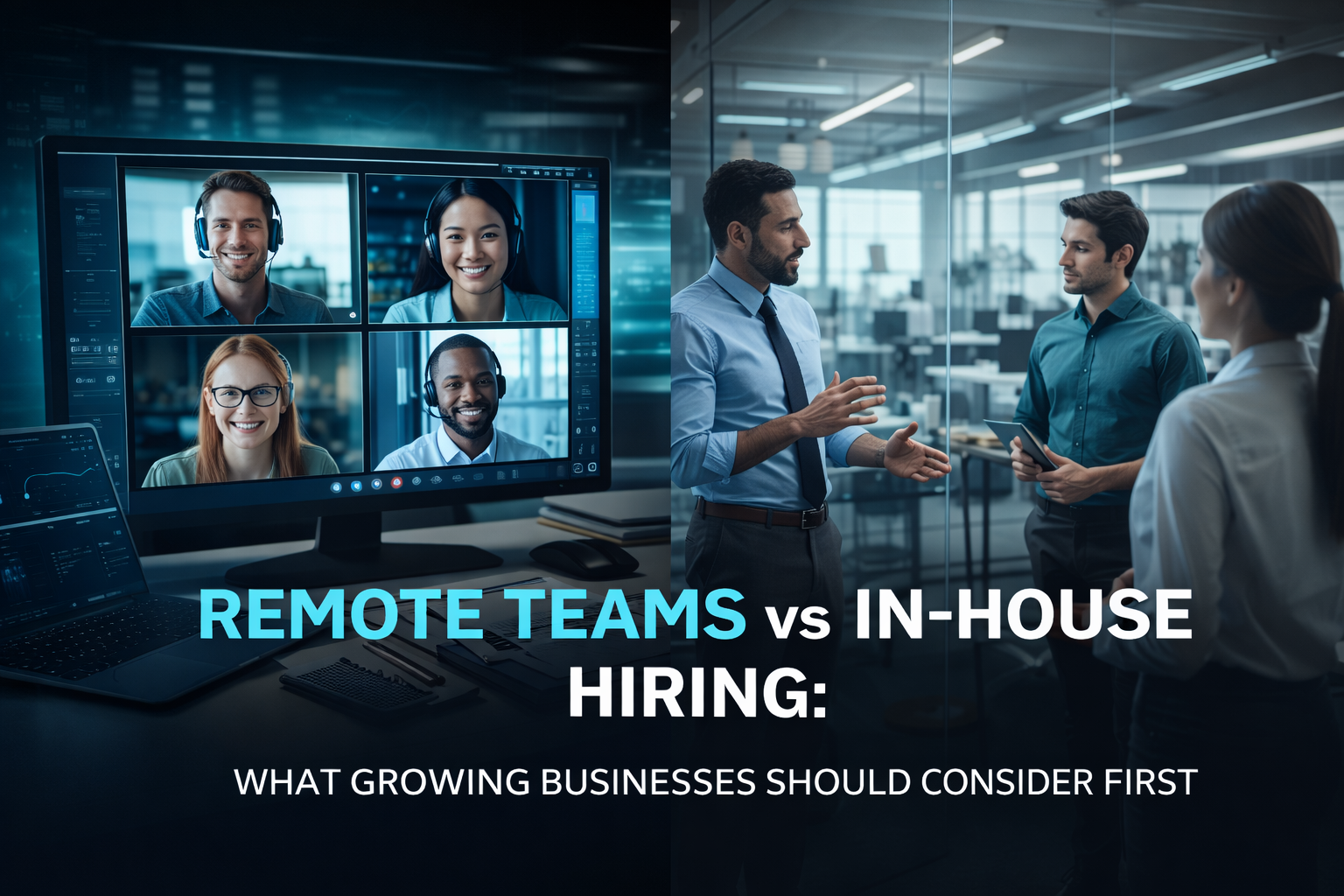
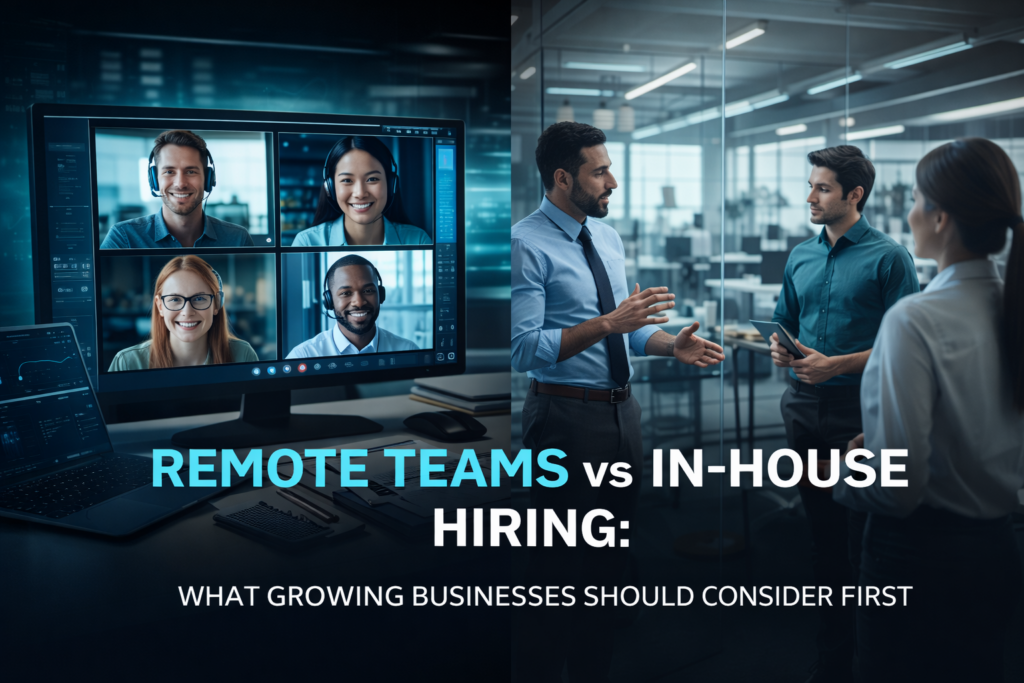
For many growing businesses, this decision shapes not only headcount but also how execution works across the company. Hiring in-house can create stronger direct control and deeper internal integration. Remote teams can create faster scalability, wider access to talent, and more adaptable support structures. The question is not which option sounds more impressive. The question is which model best supports the stage, pace, and operational reality of the business.
Before making the decision too quickly, it helps to look at both options in a practical way.
What remote teams really offer
Remote teams give businesses a way to expand operational capacity without immediately increasing the fixed burden of in-house hiring. That often means faster access to support, more role flexibility, and the ability to build around immediate execution needs rather than around a heavier internal structure from day one.
For growing companies, remote teams are often useful when the business needs help with coordination, workflow handling, delivery support, admin tasks, operational movement, or specialist execution, but is not yet ready to commit to a fully in-house structure for every role.
Remote teams are often strongest when a business needs:
- faster support expansion
- more flexible role coverage
- specialist help without immediate full-time hiring
- lower structural overhead
- better support around remote-first operations
What in-house hiring really offers
In-house hiring can create a stronger internal operating core, especially when the role needs deep brand immersion, daily in-person coordination, or long-term strategic ownership inside the company. Internal hires may be better suited for functions that need constant organizational context, leadership alignment, or highly embedded decision-making.
That said, in-house hiring usually comes with higher fixed costs, slower hiring timelines, more internal management responsibility, and less flexibility if the business is still figuring out what support structure it actually needs.
The cost question is not just salary
A common mistake is comparing remote teams and in-house hiring using salary alone. The real comparison is wider. In-house hiring often includes recruitment costs, onboarding time, management load, benefits, equipment, office considerations, and longer-term fixed commitments. Remote teams may reduce some of that overhead, especially when the business needs execution support now rather than a large internal employment structure immediately.
That is why many businesses choose remote support first, not because it is always cheaper in the simplest sense, but because it gives them more adaptable leverage while they scale.
Speed matters when growth is already happening
When a business is already feeling pressure from growth, speed becomes a serious factor. If work is piling up, follow-through is slowing down, or leaders are getting buried in coordination, waiting too long for a perfect in-house hire can be costly in its own way. Bottlenecks create lost momentum.
Remote teams can often be deployed faster, especially for support-heavy, operational, or execution-based roles. That makes them attractive for businesses that need relief quickly while still keeping options open for long-term structure later.
Control is important, but so is structure
Some businesses lean toward in-house hiring because they want more control. That is understandable, but in practice, control does not come only from physical proximity. It comes from systems, communication clarity, role structure, accountability, and process discipline.
A poorly structured in-house team can still create confusion. A well-managed remote team can still deliver strong execution. The better question is not only “Where should the person work?” but also “Do we have the structure to manage the work well?”
When remote teams may be the smarter first move
- The business needs support quickly
- Leaders need relief from execution-heavy work
- The role is operational, process-based, or specialist in nature
- The company wants flexibility before committing to fixed in-house expansion
- The business is still refining systems and does not want to overbuild too early
For many growing businesses, remote support makes the most sense first because it helps restore momentum without forcing a heavy structural decision too early.
When in-house hiring may be the better move
- The role requires constant in-person collaboration
- The function needs deep long-term internal ownership
- The business already has clear systems and can support a fixed internal role properly
- The company is investing in a mature internal leadership or department structure
- The position is core to ongoing strategic decision-making inside the business
In-house hiring can be the right move when the business is ready for it operationally and financially, not just when it sounds like the more traditional step.
A hybrid approach is often the most practical
In many cases, the best answer is not strictly remote teams or strictly in-house hiring. It is a more deliberate combination. Some businesses keep core strategic roles in-house while using remote teams to support operations, delivery, admin, specialist functions, and execution-heavy areas that need more flexible scaling.
That hybrid structure often gives growing companies the best balance between control, flexibility, speed, and cost discipline.
Final thought
Growing businesses should not decide between remote teams and in-house hiring based on habit or image. The better decision comes from understanding what kind of support the business truly needs, how fast that support is needed, and what structure is realistic at the current stage of growth.
For many modern businesses, remote teams are not a temporary compromise. They are a strategic growth lever. The right choice is the one that helps work move better, leaders operate with more clarity, and the business scale without unnecessary friction.
Frequently asked questions
Are remote teams better than in-house teams?
Not always. The better option depends on the role, the stage of growth, the speed of need, and the structure of the business. Remote teams are often stronger for flexible execution support, while in-house hires can be better for deeply embedded strategic roles.
Why do growing businesses choose remote teams first?
Because remote teams often provide faster support, more flexibility, and lower structural overhead while the business is still scaling and refining its systems.
When should a business hire in-house instead?
In-house hiring makes more sense when a role needs constant internal context, long-term strategic ownership, daily in-person collaboration, or deeper organizational integration.
Can businesses use both remote teams and in-house hiring?
Yes. A hybrid model is often the most practical setup, with in-house roles focused on core internal leadership and remote teams supporting operations, delivery, and specialist execution.
Need support?
Build the right support structure before growth gets heavier
Aevrion Ops helps growing businesses improve execution through Remote Operations, Project Delivery, Workflow Automation, and stronger Specialist Solutions.