Insights • Workflow Automation
How AI Agents Are Changing Workflow Automation for Small Businesses in 2026
Workflow automation is already helping small businesses reduce repeated manual work, improve consistency, and keep operations moving with less friction. In 2026, that shift is accelerating because AI agents are adding a new layer of capability. Instead of relying only on fixed automations that follow simple rules, small businesses are now exploring AI-supported workflows that can interpret tasks, route actions, assist with decisions, and handle more complex operational steps with less manual input.
For small businesses, this creates a major opportunity. AI agents can help teams move faster without increasing headcount too quickly. They can support lead handling, follow-up, task routing, reporting, and internal workflow coordination in ways that were harder to manage with older automation setups. But the real value is not simply that AI agents exist. The real value is how they change workflow automation from rigid task sequences into more adaptive operational support.
That is why growing small businesses should pay attention now, not just later.
What AI agents change in practical terms
Traditional workflow automation usually depends on fixed triggers and predictable actions. If a person fills out a form, then an email gets sent. If a task is marked complete, then the next step is assigned. These systems are useful, but they are limited by how much logic has been manually built into them beforehand.
AI agents can extend this by supporting workflows that need a little more interpretation, prioritization, or context handling. They can help sort leads, recommend next actions, prepare summaries, support internal routing, or coordinate information across tools in a more flexible way. That makes workflow automation more useful for small businesses that need smarter support without building overly complex systems from scratch.
In simple terms:
- workflow automation handles repeated process logic
- AI agents help make that logic more adaptive and useful
- together they can create better operational flow for small teams
Why this matters for small businesses
Small businesses often feel the cost of operational inefficiency more sharply than larger organizations. A missed follow-up, delayed handoff, forgotten task, or slow response can have a bigger effect when the team is lean. That is why workflow automation has always mattered. But AI agents make it more relevant because they can help small teams handle more complexity without requiring the business to become larger before its systems become smarter.
Instead of automating only simple actions, small businesses can begin to improve coordination, responsiveness, internal movement, and process support in a more practical way. That can create real leverage when the business is growing but still trying to stay lean.
Where AI agents are already improving workflow automation
The most useful impact is happening in workflows that repeat often, involve multiple steps, and need more than simple trigger-response logic. Small businesses do not need to automate everything at once. They should start where AI agents can reduce friction clearly and measurably.
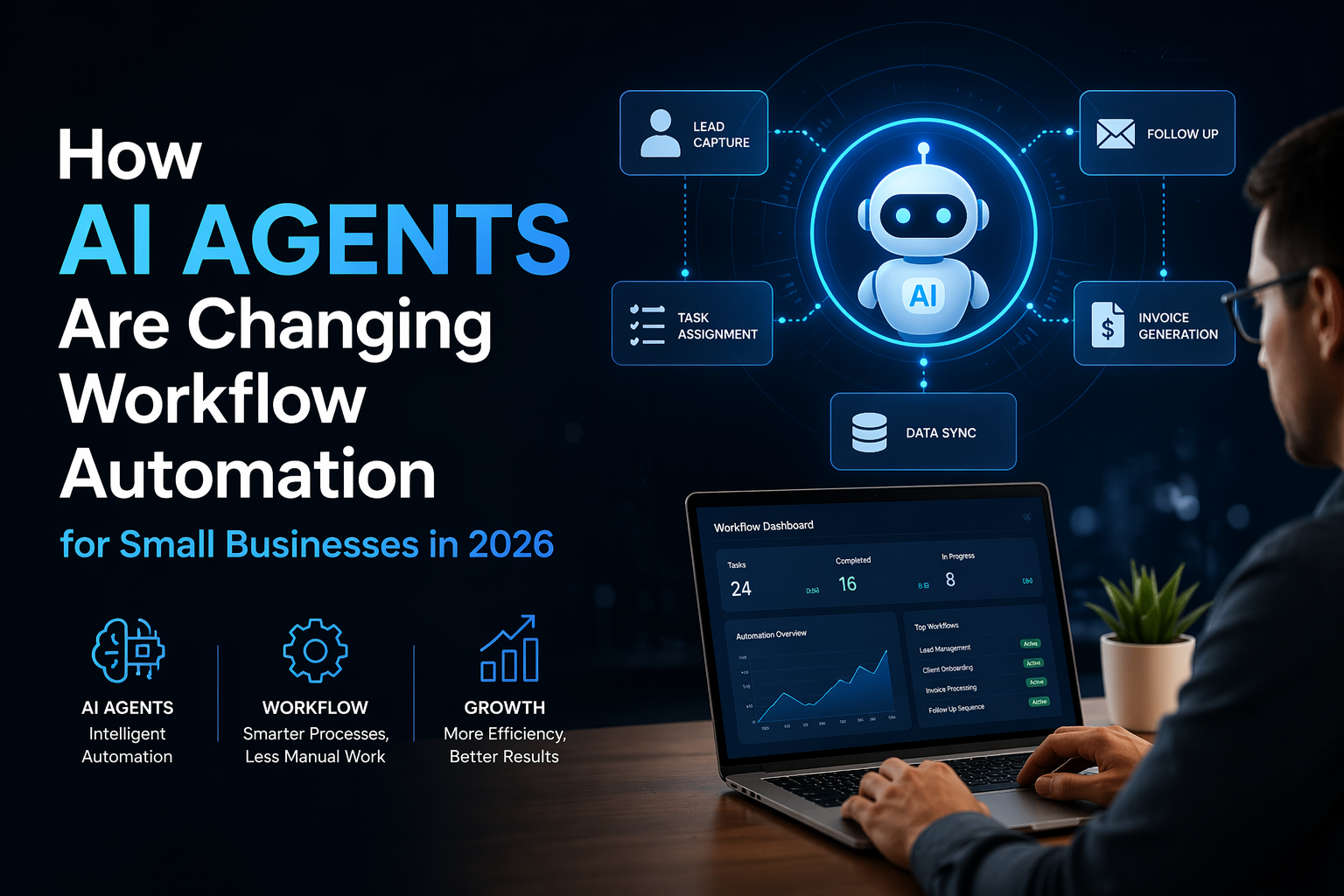
- Lead capture and qualification support
- Follow-up message drafting and sequencing
- Task assignment and workflow routing
- Invoice and document workflow handling
- Reporting summaries and internal updates
- Data syncing between connected systems
- Customer request triage and next-step support
These are the kinds of workflows where AI agents can help small businesses move beyond basic automation into more capable operational systems.
AI agents do not replace workflow discipline
One of the biggest mistakes small businesses can make is assuming AI agents fix weak processes automatically. They do not. If the workflow itself is unclear, inconsistent, or already poorly managed, then adding AI usually makes the confusion faster, not better. AI agents still need good systems underneath them.
That means the best results come when a small business first understands the workflow, simplifies the steps, and then uses AI agents to support that structure. Operational clarity still matters. In fact, it matters even more when systems become more capable.
How this changes the automation decision for small businesses
Before AI agents became practical, some small businesses viewed workflow automation as helpful but limited. It could handle reminders, triggers, and repeated sequences, but not much else. Now the question is shifting. Businesses are asking how much more operational support can be added without expanding manual work.
That changes the decision from “Should we automate this one task?” to “How should we design this workflow so the system can support more of the work intelligently?” That is a much more strategic question, and it is why AI agents are changing workflow automation so noticeably in 2026.
What small businesses should automate with AI agents first
The best first opportunities are still the workflows that happen often and create repeated friction. AI agents do not change that principle. They just expand what can be supported inside those workflows.
Strong first use cases include:
- lead follow-up workflows
- client onboarding processes
- task triage and assignment
- reporting preparation
- customer intake and request handling
- invoice and admin workflow support
These workflows usually provide fast operational value because they are frequent enough to matter and structured enough to improve with better automation support.
Why human oversight still matters
Even when AI agents are useful, human oversight is still part of the system. Small businesses should not treat AI workflow support as something that runs without supervision. The strongest use comes from balancing automation with review, especially for sensitive communication, brand voice, client-facing messaging, or decisions that need context beyond what a system can reliably interpret.
The practical mindset is not “let the AI run everything.” It is “use AI agents where they improve flow, but keep people responsible for quality, judgment, and control.”
Final thought
AI agents are changing workflow automation for small businesses in 2026 because they are making automation more adaptive, more useful, and more closely tied to real operational work. That does not mean small businesses should rush blindly into every AI tool they see. It means they should identify the workflows that matter most, strengthen the process behind them, and use AI agents in ways that make the business easier to run.
For small businesses, the real promise is not just smarter technology. It is better execution with less manual drag.
Frequently asked questions
How are AI agents changing workflow automation?
AI agents make workflow automation more adaptive by helping systems handle multi-step tasks, routing decisions, summaries, and support actions that go beyond simple fixed triggers.
Can small businesses use AI agents effectively?
Yes. Small businesses can use AI agents effectively when they apply them to repeated, structured workflows such as lead follow-up, task assignment, onboarding, reporting, and admin support.
Should AI agents replace human workflow management?
No. AI agents should support workflow execution, but human oversight is still important for quality, judgment, brand-sensitive communication, and overall operational control.
What should small businesses automate first with AI agents?
Start with high-frequency workflows that create repeated friction, especially lead handling, onboarding, task routing, admin support, reporting, and customer intake workflows.
Need support?
Build smarter workflows before manual work slows your business down
Aevrion Ops helps growing businesses improve execution through Workflow Automation, Automation Support, Technical Execution, and stronger Remote Operations.