
Insights • SEO
AI Search in 2026: How Businesses Stay Visible Beyond Traditional SEO
Search in 2026 is no longer just about ranking web pages and waiting for clicks. Businesses are now competing for visibility across AI-generated answers, search summaries, conversational interfaces, and discovery paths that often happen before a user ever reaches a traditional results page. That shift is changing how brands need to think about SEO.
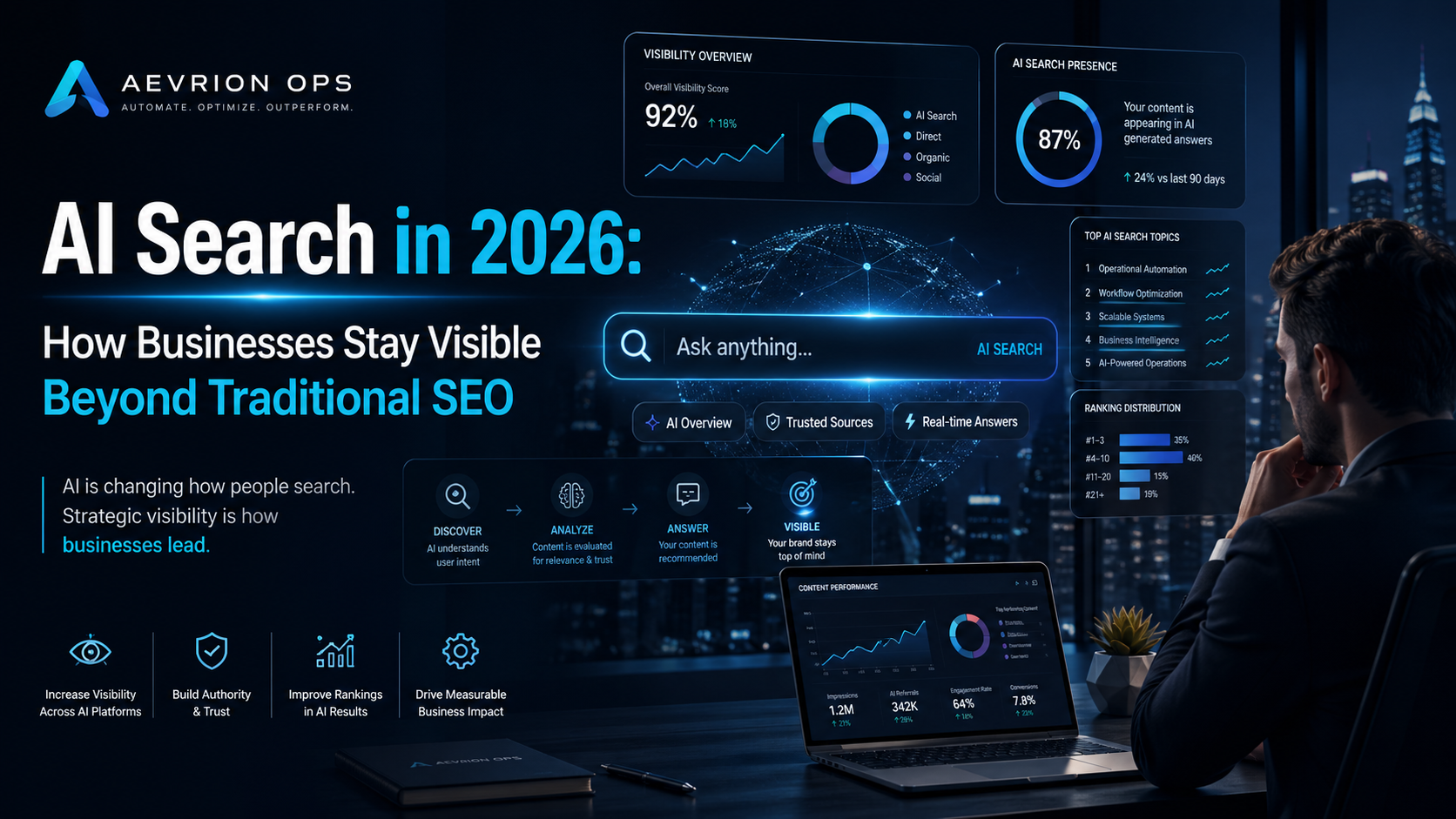
Traditional SEO still matters, but it is no longer the full picture. A business may rank well and still lose visibility if it is absent from AI-generated responses, cited summaries, or emerging search experiences where users are getting direct answers instead of scanning ten blue links. That is why visibility now has to be understood more broadly.
For businesses that want to stay competitive, the real question is no longer just “How do we rank?” It is “How do we stay discoverable wherever people search now?”
Why AI search changes the visibility game
AI search changes how people discover information because the experience is more interpretive, more conversational, and more synthesized. Instead of only presenting a list of links, AI-powered search systems increasingly summarize, compare, and recommend. That means the user may interact with the answer itself before ever deciding whether to click through.
For businesses, this changes the visibility objective. It is no longer enough to optimize only for page position. Your content, expertise, and brand signals also need to be structured in ways that make them easier for AI systems to understand, trust, retrieve, and reference.
In simple terms:
- traditional SEO helps you rank
- AI search visibility helps you get referenced, summarized, and recommended
- modern search strategy now needs both
Why traditional SEO alone is no longer enough
Traditional SEO still plays a foundational role. Technical structure, content relevance, page quality, internal linking, and authority signals still matter. But if a business relies only on classic SEO thinking, it risks optimizing for a narrower version of search than what users are now experiencing.
Today, search visibility also depends on whether your business is present in the information layer that AI systems draw from. That means stronger content structure, clearer topical authority, broader digital consistency, and better alignment between what your brand says, what your site shows, and what the wider web confirms.
What businesses need to optimize for now
The most effective search strategy in 2026 is broader than classic SEO. Businesses need to think about visibility across both traditional search surfaces and AI-driven discovery surfaces.
- Content that clearly answers real questions
- Topical authority built around core service areas
- Strong page structure and semantic clarity
- Credible, consistent brand signals across the web
- Useful, original content that can be cited or referenced
- Digital entities and business information that are easy to validate
- Search experiences designed for both humans and AI systems
This is why visibility is becoming a more strategic discipline. It is no longer only about optimizing pages. It is about building an information footprint that search systems can interpret with confidence.
How AI search rewards different content behavior
AI search tends to reward content that is useful, well-structured, context-rich, and easy to interpret. Content written only to target keywords without offering real clarity or substance is less likely to perform well when the system is trying to synthesize answers instead of only rank pages.
That means businesses should think more carefully about how content is written, how expertise is expressed, and how clearly each page helps answer a real question. Clarity, trust, usefulness, and consistency now carry even more weight.
What this means for business websites
A business website in 2026 should still be optimized technically, but it also needs to be easier to understand as a source of expertise. That means clear service pages, strong supporting articles, better entity consistency, clean internal linking, and content that is written for real search intent rather than generic traffic volume alone.
Businesses that want visibility beyond traditional SEO should also think about whether their content is helping them appear as a trusted source, not just a searchable page. The structure of the site, the depth of the content, and the credibility of the brand all contribute to that outcome.
How businesses can stay visible now
The practical move is not to abandon SEO. It is to evolve it. Businesses should continue strengthening their search foundations while also preparing content and systems for AI-driven discovery.
A strong 2026 visibility strategy should include:
- better question-led content creation
- clear service and expertise positioning
- content clusters around core topics
- cleaner on-page structure
- stronger trust and authority signals
- consistency across website, profiles, and brand mentions
- ongoing measurement of visibility, not just rankings
Businesses that make this shift earlier will be better positioned as search continues to move toward answer-based and AI-assisted experiences.
Final thought
AI search in 2026 is not replacing SEO. It is expanding what visibility means. Businesses that want to stay discoverable need to think beyond rankings alone and build a stronger presence across the broader search ecosystem. The businesses that adapt will not just be easier to find. They will be easier to trust, easier to reference, and harder to ignore.
That is the real shift: from ranking pages to building visibility wherever search happens.
Frequently asked questions
What is AI search?
AI search refers to search experiences that use AI to interpret queries, synthesize information, and generate direct answers or summaries instead of only presenting a traditional list of links.
Is traditional SEO still important in 2026?
Yes. Traditional SEO still matters, but it now needs to be supported by broader AI visibility strategy so businesses can stay discoverable across both classic search and AI-generated answer surfaces.
How do businesses stay visible in AI search?
Businesses stay visible by creating clear, trustworthy, structured content, strengthening topical authority, maintaining strong brand consistency, and optimizing for discoverability across more than just traditional search rankings.
What is the difference between SEO and GEO?
SEO focuses on improving visibility in traditional search results. GEO, or generative engine optimization, focuses more on helping content appear in AI-generated answers, summaries, and recommendation layers.
Need support?
Build stronger visibility across both search and AI discovery
Aevrion Ops helps growing businesses improve visibility through stronger SEO strategy, better content structure, AI-aware optimization thinking, and broader operational support built for modern discovery.