Insights • Automation Support
AI Agents for Business in 2026: How Growing Companies Can Use Them Without Losing Control
AI agents are becoming one of the most talked-about business tools in 2026. Companies are no longer just experimenting with chatbots or isolated AI features. They are starting to explore AI agents that can follow instructions, trigger workflows, handle repeated tasks, support decision-making, and connect across business systems. For growing companies, this creates real opportunity. It also creates a serious operational question: how do you use AI agents without losing clarity, control, and trust in how work gets done?
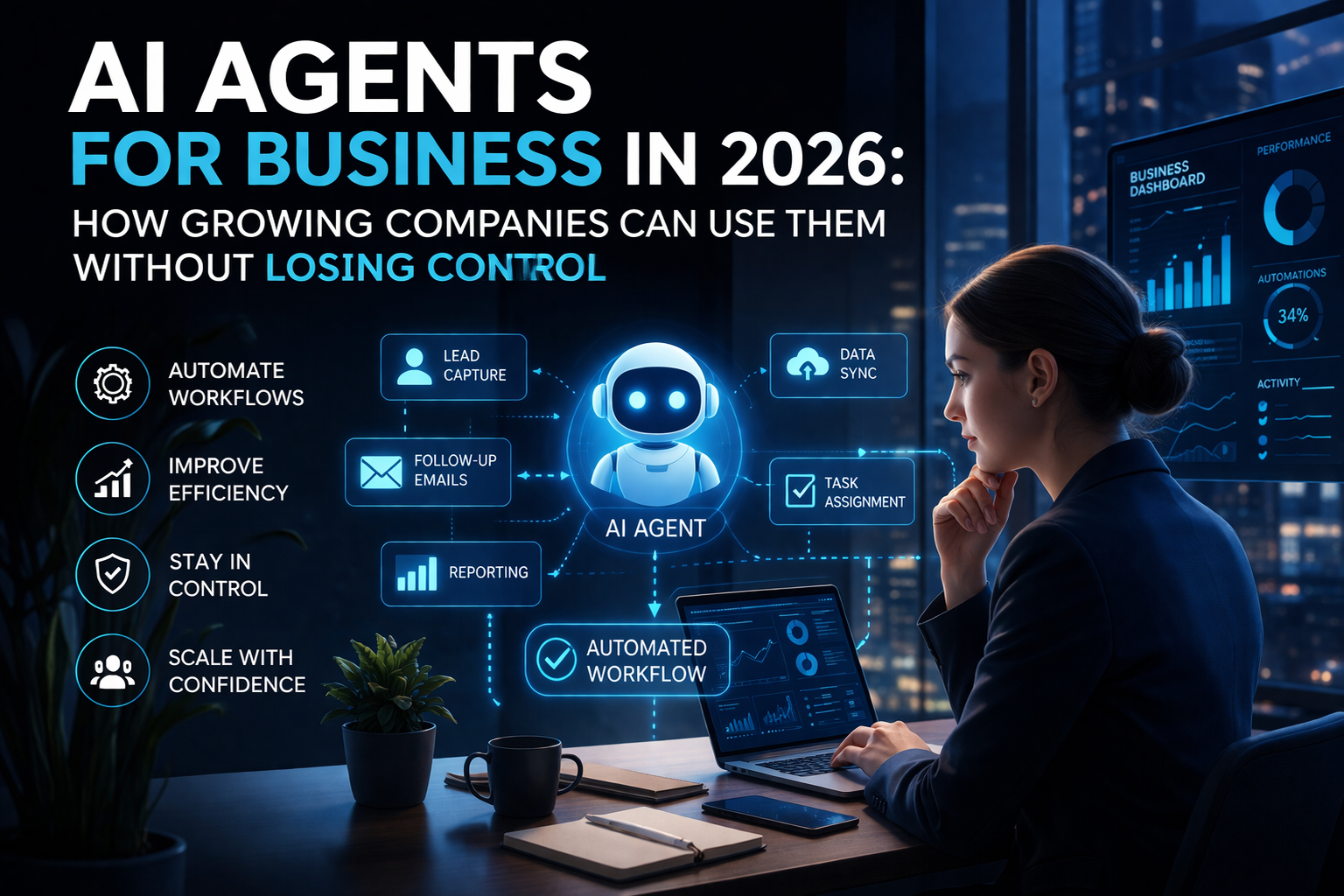
That question matters because growing businesses do not need more operational confusion wrapped in impressive language. They need systems that improve execution. AI agents can absolutely help, but only when they are introduced with structure, proper boundaries, and clear human oversight. The goal should never be to hand over the business blindly. The goal is to use AI agents in ways that reduce drag, support workflow quality, and strengthen how the business operates.
For growing companies in 2026, the most practical path is not total automation. It is controlled implementation.
What AI agents actually mean for business
In practical terms, AI agents are systems that can carry out tasks with a higher level of initiative than traditional automation. Instead of only following one fixed trigger, they may be able to interpret instructions, manage multi-step actions, connect to tools, retrieve information, and complete parts of a workflow with less manual prompting along the way.
That sounds powerful, and it is. But business value does not come from the novelty of the agent itself. It comes from how well the agent fits into a real operational system. If an AI agent cannot be trusted, monitored, or constrained properly, it becomes a risk instead of a support layer.
The right mindset:
AI agents should be treated as controlled operational tools, not independent replacements for human judgment.
Where growing companies can use AI agents well
The best use cases are usually the ones where work is repeated, structured, and still needs faster handling. AI agents can be useful when they support workflows that already have some logic behind them and when the human team remains clearly responsible for final oversight where needed.
- Lead capture and qualification support
- First-response messaging and follow-up handling
- Task routing and workflow assignment
- Data syncing between connected systems
- Internal reporting preparation
- Knowledge retrieval for team support
- Operational reminders and status monitoring
In these cases, AI agents can reduce repeated effort without requiring the business to surrender important strategic or judgment-based decisions.
Why control becomes the real issue
The biggest risk is not simply that AI agents exist. The risk is that businesses start using them without clear boundaries. If an AI agent has access to customer data, workflow actions, internal tools, or communication systems, then poor setup can create confusion, bad outputs, trust damage, or operational mistakes at scale.
That is why growing companies should think about control before they think about capability. A more capable system without strong oversight is not necessarily a better system. It may simply be a faster way to create bigger mistakes.
What controlled implementation looks like
Using AI agents without losing control means defining clear limits around what they can do, where they operate, what systems they can access, and when human review is still required. It also means monitoring outcomes instead of assuming that because the workflow is automated, it is automatically correct.
- Define the exact scope of the agent
- Limit permissions to what is necessary
- Keep high-risk decisions under human review
- Log actions and outcomes clearly
- Test the workflow before wider rollout
- Review edge cases, not just normal cases
- Maintain documentation around what the agent does
This approach keeps AI agents in the role they should play: amplifiers of structured execution, not uncontrolled actors inside the business.
What businesses should not delegate to AI agents too early
Growing companies should be careful about handing over tasks that involve sensitive judgment, nuanced client communication, brand-critical positioning, or high-risk operational authority too early. Not everything should be turned into an agent-managed workflow just because the technology can support it.
- Final approval on sensitive customer responses
- Strategic decision-making without review
- High-trust internal leadership communication
- Unrestricted access to critical systems
- Open-ended financial or legal actions
The safer path is to use AI agents first where the process is structured enough to benefit from speed, but not so sensitive that an unreviewed mistake creates real damage.
Why growing companies need operational structure first
AI agents work best inside businesses that already understand their workflows. If the process itself is unclear, constantly changing, or managed differently every time, then adding an agent usually makes the mess faster, not better. Operational clarity should come before agent adoption.
This is why growing companies should treat AI agent adoption as part of a wider workflow and systems strategy. The underlying process should be understandable, the inputs should be clear, and the outcomes should be measurable. Otherwise, the business is automating instability.
A practical first step for small and growing companies
A smart first step is to identify one or two workflows where the team is already doing repeated structured work manually. That could be lead follow-up, routine reporting support, task triage, document handling, or internal data movement between tools. Then build controlled agent support around that workflow first instead of trying to redesign the entire business around AI in one move.
A good first agent workflow should be:
- repeated often
- clear in structure
- lower risk in outcome
- easy to monitor
- useful enough to save real time
That lets the business learn how to use AI agents responsibly while building confidence through actual operational value.
Final thought
AI agents can absolutely help growing companies in 2026. They can improve efficiency, reduce repeated work, and support cleaner workflow movement across the business. But the companies that benefit most will not be the ones that rush the fastest. They will be the ones that implement agents with clear scope, strong guardrails, and better operational thinking behind the system.
The goal is not to lose control to AI. The goal is to use AI agents as controlled business tools that help work move with more clarity, more speed, and more discipline.
Frequently asked questions
What are AI agents in business?
AI agents are systems that can help handle multi-step business tasks with more initiative than basic automation, often by interacting with tools, retrieving information, and supporting structured workflows.
How can a growing company use AI agents without losing control?
By limiting scope, restricting permissions, keeping sensitive decisions under human review, logging actions clearly, and introducing agents first in lower-risk structured workflows.
What should businesses automate with AI agents first?
Start with repeated, structured, lower-risk workflows such as lead follow-up support, task routing, data syncing, reporting preparation, and internal workflow handling.
Are AI agents the same as workflow automation?
Not exactly. Workflow automation usually follows fixed logic. AI agents can support more adaptive task handling, but they still need structure, boundaries, and operational oversight to work well in a business setting.
Need support?
Use AI as a business support layer, not a source of operational chaos
Aevrion Ops helps growing businesses improve execution through Automation Support, Workflow Automation, Technical Execution, and stronger Remote Operations.